Pearson Edexcel · GCSE · Mathematics
Course version: 1MA1 · Version from Mar 2026
Geometry and measures - Mensuration and calculation: apply the concepts of congruence and similarity, including the relationships between lengths, areas and volumes in similar figures (Higher tier)
Why does doubling a model’s height require four times the paint but eight times the filling material? Master congruence proofs and the k, k², k³ relationships, then use roots to tackle the reverse-scaling questions that distinguish strong Higher-tier answers.
- 12 min read
- 5 worked examples
- 6 practice questions
- 11 key terms
Try the lesson
The start of the Geometry and measures - Mensuration and calculation: apply the concepts of congruence and similarity, including the relationships between lengths, areas and volumes in similar figures (Higher tier) lesson, made from checked teaching notes for this specification point.
Have a go first
Two similar cylinders have heights in the ratio 2 : 5. The volume of the smaller cylinder is 40 cm³. Work out the volume of the larger cylinder.
There is more to this lesson
The full lesson goes on to check your understanding and help you earn the marks. Create a free account to carry on, with your progress saved.
7 days Premium · Then the free plan continues · No card, no charge
Check what you remember
Read the wording for your board, then hide it and explain Congruent in your own words. Rough notes are fine. This is a self-check, with no mark or grade.
Reference: Pearson Edexcel
Having the same shape and size, with equal corresponding lengths and angles.
Study Notes
Overview
An enlarged photograph, a scale model and a larger storage container all raise the same mathematical question: which quantities change, and by how much? Congruence means identical shape and size. Similarity preserves shape, but corresponding lengths may change by a common factor. The Higher-tier challenge is distinguishing a length factor from an area factor or a volume factor, then reversing those relationships when necessary.
This guide targets Pearson Edexcel GCSE Mathematics 1MA1, G19, with supporting triangle proofs from G5 and G6. Congruence and length similarity occur at both tiers; the G19 relationships involving areas and volumes are Higher-only. Do not assume the entire topic is exclusive to Higher. 1
Candidates may be asked to calculate a missing side, prove triangles congruent or similar, scale a surface area or volume, or recover a length from an area or volume ratio. These questions connect ratio, powers, roots, transformations, mensuration and algebra. A reliable solution identifies corresponding measurements, fixes the direction of comparison, and selects the correct power. Examiners need visible mathematical reasoning, particularly when the command is show that or prove. 2 3
Key Concepts
1. Congruence: identical shape and size
Two shapes are congruent when they have the same shape and size. Their corresponding lengths and angles are equal. Moving, turning or reflecting a shape does not change this. Congruent shapes are therefore also similar, with length factor 1.
For triangles, SSS means three corresponding sides are equal. SAS means two corresponding sides and their included angle are equal. ASA means two corresponding angles and the included side are equal. If a different corresponding side is known, establish the third angle first and use ASA. RHS means both triangles are right-angled, with equal hypotenuses and one other corresponding side equal. 1
Candidates should identify the facts, name the test, and conclude with matching vertex order. For example, AB = DE, AC = DF and angle BAC = angle EDF establish triangle ABC congruent to triangle DEF by SAS. The angle lies between the named sides. Credit is not earned merely by asserting that two drawings look identical.
Cover and recall: why is AAA not a congruence test? Equal angles do not fix size: triangles with sides 3, 4, 5 and 6, 8, 10 have matching angles but different lengths.
2. Similarity: identify the correspondence
Similar figures have equal corresponding angles and corresponding lengths in a constant ratio. An enlargement preserves angles and multiplies every length by the same factor. Orientation is irrelevant: a rotated or reflected figure can still be similar.
For triangles, two equal corresponding angles establish similarity because the third angles also agree. Alternatively, use three proportional corresponding side pairs, or two proportional side pairs with equal included angles. Do not confuse these proportional-side conditions with equal-side congruence conditions.
These triangle shortcuts do not automatically apply to other polygons. A 2 by 3 rectangle and a 2 by 5 rectangle both have four right angles, yet they are not similar. Likewise, two cylinders are not necessarily similar: radius and height must change in the same ratio.
Match sides by geometry, not page position. If triangle ABC corresponds to DEF, then AB matches DE, BC matches EF, and AC matches DF. An altitude matches the corresponding altitude. In a parallel-line triangle problem, establish the equal angles before setting up the side ratios.
3. The length factor and its direction
Define k = length in B ÷ corresponding length in A, for the direction A to B. Convert units before dividing. Matching heights 4 cm and 6 cm give k = 6/4 = 3/2. Every corresponding length in B is 3/2 times its length in A. This includes radii, diameters, heights, diagonals and perimeters.
If A has a matching side of 10 cm, B has 10 × 3/2 = 15 cm. Going backwards, use 2/3, or divide by 3/2. For a reduction, 0 < k < 1. A missing length in the smaller figure should not exceed its larger counterpart.
Keep k exact where possible. The fraction 7/3 is safer than prematurely replacing it with 2.3. Squaring or cubing a rounded factor amplifies the error. Here k means a positive measurement ratio. A negative transformation scale factor changes position relative to the centre; its corresponding length multiplier is its absolute value.
4. Why areas scale by k²
A rectangle has area length × width. Replacing those dimensions with k × length and k × width gives k² × original area. A triangle's base and perpendicular height both scale, producing the same squared factor. A circle's radius is squared in πr², so its area follows the same rule.
The rule extends to corresponding areas and total surface areas of similar solids. Every face area scales by k², so adding the face areas preserves that factor. It is wrong to cube a surface area simply because the object is three-dimensional: the requested measure is still an area.
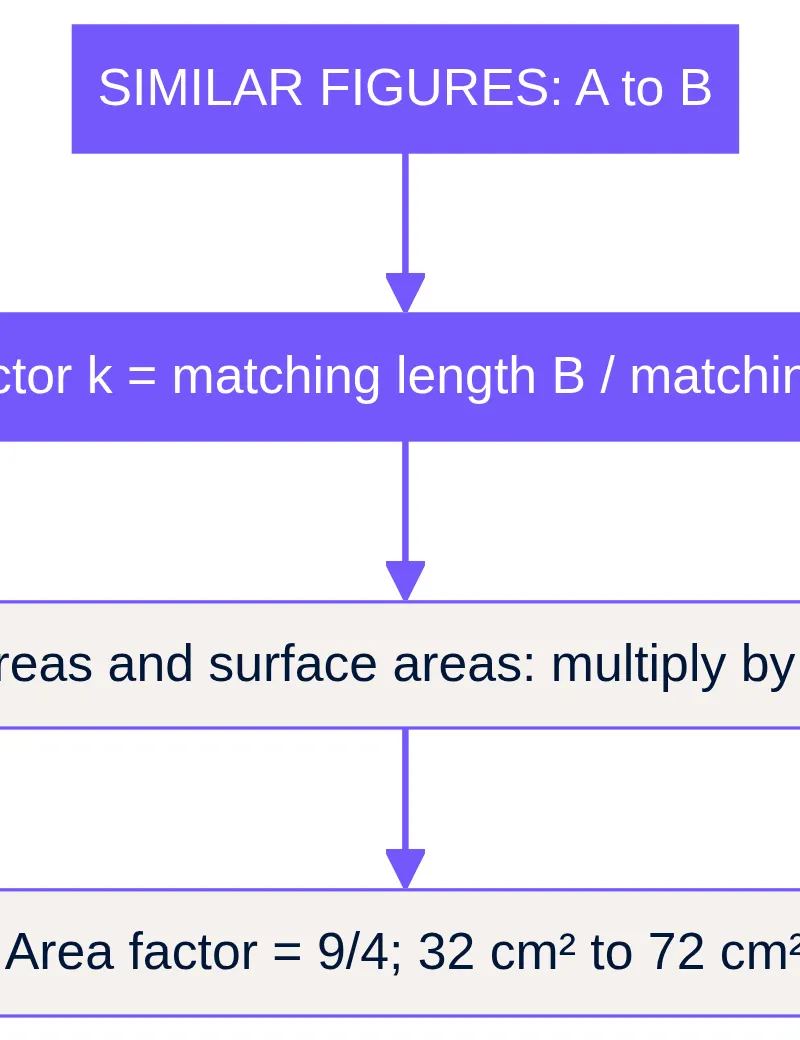
With k = 3/2, the area factor is 9/4 = 2.25. A surface area of 32 cm² becomes 32 × 9/4 = 72 cm². Multiplying by 3/2 alone gives 48 cm² and ignores the second scaled dimension. For an enlargement, that incorrect answer is too small; for a reduction, scaling by k alone makes the answer too large.
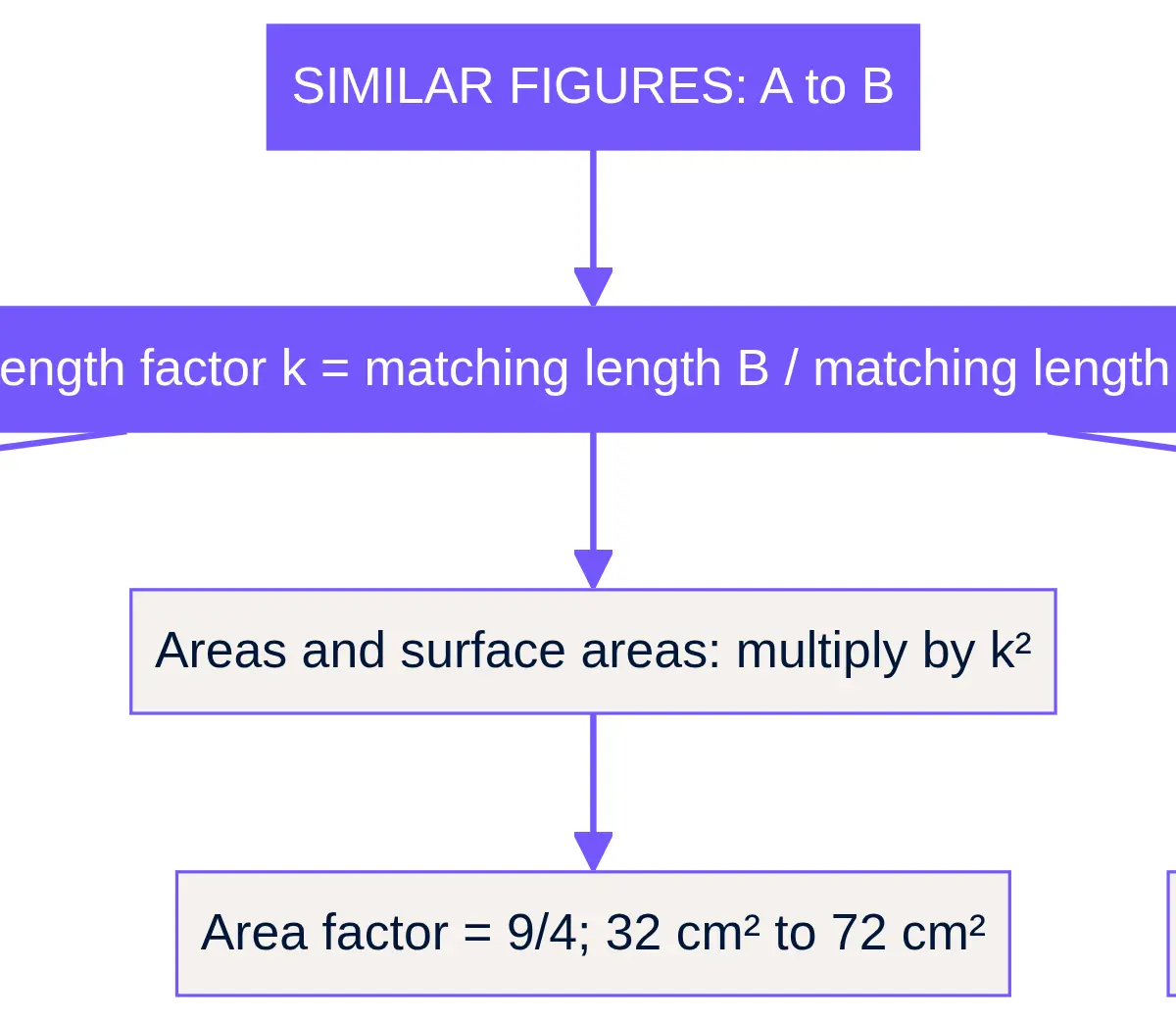
Why does this work? A square whose side doubles has four copies of the original square inside it, not two. The extra area comes from scaling in two independent directions.
5. Why volumes scale by k³
A cuboid has volume length × width × height. Scaling all three dimensions gives three factors of k, hence k³. A prism's cross-sectional area contributes k² and its length contributes k, giving k³ overall. The rule applies to any mathematically similar solids, including cones and spheres, without needing to calculate their individual volumes from scratch.
With k = 3/2, the volume factor is 27/8 = 3.375. A volume of 24 cm³ becomes 24 × 27/8 = 81 cm³. Doubling lengths gives eight times the volume; trebling lengths gives twenty-seven times the volume.
Similarity must be established or stated. If a cylinder's radius doubles while its height remains fixed, its volume becomes four times as large, not eight times, because the cylinders are not similar. Candidates should use the actual dimensional change rather than automatically applying k³.
6. Work backwards with roots
If the given quantities are areas, their ratio is k². Undo squaring with a square root. Areas 50 cm² and 98 cm² give k = √(98/50) = √(49/25) = 7/5. A corresponding length of 15 cm therefore becomes 15 × 7/5 = 21 cm, not 29.4 cm.
If the given quantities are volumes, their ratio is k³. Undo cubing with a cube root. Volumes 54 cm³ and 128 cm³ give k = ∛(128/54) = ∛(64/27) = 4/3. To compare surface areas, square this recovered length factor: 16/9.
For mixed-measure questions, make length your home base: given measure → recover k → required measure. An area ratio 4:9 gives length ratio 2:3 and volume ratio 8:27. Never cube 4:9 directly, because it is already an area ratio.
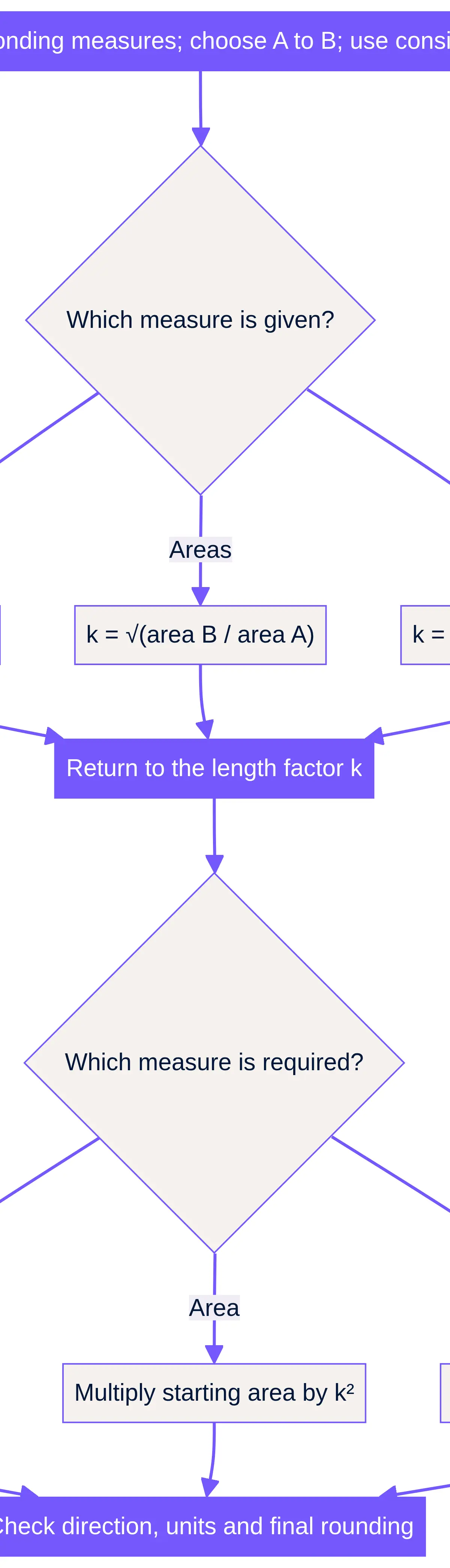
Cover and recall: an area factor is 0.36. What are the length and volume factors? Recover k = 0.6, then cube it to get 0.216.
7. Ratios, percentages and compound problems
If corresponding lengths have ratio a:b, areas have ratio a²:b² and volumes have ratio a³:b³. Preserve the order throughout. Ratios need not contain whole numbers; the same rules apply to fractions and decimals.
A 20% increase in every length means k = 1.2. The area factor is 1.44, a 44% increase, and the volume factor is 1.728, a 72.8% increase. Do not square or cube the percentage increase itself. First convert the change to a multiplier.
For a frustum obtained by cutting a cone parallel to its base, compare the removed small cone with the original whole cone. Those cones are similar. Find the small-cone volume by scaling, then subtract it. The frustum itself is not similar to the whole cone, so its height ratio cannot be cubed to find its volume.
Mathematical Relationships and Formula Status
Here L means a corresponding length, P a perimeter, A an area or surface area, and V a volume. Subscripts A and B identify the two figures. All ratios use consistent units. These relationships are Must memorise: they do not appear on the inspected 2026 Pearson Higher formula sheet. 4
- k = L_B/L_A; L_B = kL_A; P_B = kP_A.
- A_B = k²A_A; V_B = k³V_A.
- k = √(A_B/A_A); k = ∛(V_B/V_A).
- L_A = L_B/k; A_A = A_B/k²; V_A = V_B/k³.
- Length ratio a:b → area ratio a²:b² → volume ratio a³:b³.
- Area-to-volume factor: (A_B/A_A)^(3/2). Volume-to-area factor: (V_B/V_A)^(2/3). These are equivalent shortcuts; recovering k first is usually clearer.
- Percentage increase = (factor − 1) × 100%; percentage decrease = (1 − factor) × 100%.
Useful underlying mensuration formulas are: rectangle area lw, square area s², triangle area bh/2, cuboid volume lwh, cube volume s³, cuboid surface area 2(lw + lh + wh), and cube surface area 6s²: Must memorise because these explicit formulas are not listed on that sheet. Here b and h are perpendicular base and height; s is a side; l, w and h are length, width and height.
Circle area πr² and circumference 2πr = πd are Given on formula sheet. Prism volume = cross-sectional area × length is Given on formula sheet. Cylinder volume πr²h follows by combining the supplied circle-area and prism-volume relationships. Trapezium area (a + b)h/2 is Given on formula sheet, with parallel sides a and b and perpendicular separation h. These formulas explain scaling, but are usually unnecessary when a question already supplies an original area or volume. 4
Formula-sheet labels refer to the verified 2026 sheet. Pearson reports continued provision for the current specification; consult the sheet for your own examination series rather than assuming future wording is identical. 5
Units, Graphs and Checking
Length ratios are dimensionless. Mixed units must be converted before comparison: 1.5 m and 50 cm give 150/50 = 3, not 1.5/50. Since conversions also scale dimensions, 1 m² = 10,000 cm² and 1 m³ = 1,000,000 cm³. Also, 1 cm² = 100 mm², 1 cm³ = 1,000 mm³, 1 litre = 1,000 cm³, and 1 ml = 1 cm³.
Check plausibility after calculating. For k > 1, k³ > k² > k; for 0 < k < 1, the inequality reverses. This compares the factors, not differently measured numerical quantities with incompatible units. At k = 1, every factor is 1.
For a fixed family of similar shapes, A = cL² and V = dL³, with constants c and d determined by the shape. Their graphs against L are curves, not straight lines. A plotted against L² and V against L³ gives straight lines through the origin. Label axes with the quantity and its correct units, such as L² in cm². Do not assume equally spaced volumes correspond to equally spaced lengths.
Practical Applications and Revision
Scale models illustrate why a model at length scale 1:10 has area scale 1:100 and volume scale 1:1,000. Painting a similar object relates to surface area; filling it relates to volume. Mass follows volume only if density is unchanged. Cost follows area or volume only when the stated pricing assumptions justify it.
There is no required practical for this GCSE mathematics topic. An optional investigation is to draw squares of sides 1, 2 and 3 units and count their unit squares, then compare cubes of those side lengths. Predict the factors before checking: this turns the picture into a test of your reasoning.
Listen to the ten-minute revision podcast, then attempt the worked examples and practice questions without looking at the answers.
After each question, explain why the chosen power was appropriate. Reattempt missed questions tomorrow and several days later. Accurate retrieval is more useful than recognising a solution you have just read.
Sources and Marking Note
Worked Example 2 uses Pearson's genuine sample question and its published three-mark scheme. Other questions are original Edexcel-style teaching questions with illustrative mark allocations, not official Pearson mark schemes. Actual method, accuracy and follow-through credit depends on the question's published scheme.

Worked Examples
5 worked examples — open one to explore the question and available guidance.
Practice Questions
Try the question, then reveal an answer plan or example response
Original Edexcel-style question, 3 marks. Similar triangles A and B have corresponding sides 6 cm and 9 cm. Another side of A is 8 cm. Work out the corresponding side of B.
Hint: Use the matching 6 cm and 9 cm sides to find the A to B factor.
Original Edexcel-style question, 3 marks. Angle ABC and angle DEF are both 90°. AC = DF = 13 cm and AB = DE = 5 cm. Prove that triangle ABC is congruent to triangle DEF.
Hint: Identify the hypotenuse in each triangle.
Original Edexcel-style question, 3 marks. Two similar solids have corresponding lengths in the ratio small:large = 3:5. The larger solid has surface area 250 cm². Calculate the smaller surface area.
Hint: Surface area is an area measure, even though the figures are solids.
Original Edexcel-style question, 4 marks. Similar solids A and B have volumes 125 cm³ and 343 cm³. The surface area of A is 150 cm². Calculate the surface area of B.
Hint: Recover a length factor from the volume ratio before comparing areas.
Original Edexcel-style question, 5 marks. Similar solids A and B have surface areas 72 cm² and 162 cm². The height of A is 10 cm and the volume of B is 81 cm³. Work out the height of B and the volume of A.
Hint: Use one factor from A to B, then its reciprocal when returning from B to A.
Original Edexcel-style question, 4 marks. Every length of a solid is increased by 20% to form a similar solid. Work out the percentage increases in (a) surface area and (b) volume.
Hint: Convert the length increase to a multiplier, then distinguish a factor from a percentage increase.
Exam technique
How to turn what you know into marks
How to approach the question
Read the command word and required measure. Confirm similarity or identify the proof facts. Write the direction, match the measurements and convert units. Recover k from lengths, areas or volumes; then apply the power needed for the answer. Keep exact values and check the result against enlargement or reduction.
How to structure your answer
For a calculation: labelled ratio or factor → correct root/power → substitution → final answer with units. In a 3-mark mixed-scaling question, recovering k, applying the next power and obtaining the result may be the three assessed stages, as in the authentic sample question. For a 5-6-mark compound problem, separate each requested result and show any subtraction. For a proof: named corresponding facts → valid criterion → conclusion with matching vertices. Marks follow the published scheme, not a guaranteed mark for every line.
Timing
Each Pearson Edexcel 1MA1 paper has 80 marks in 90 minutes: 1.125 minutes per mark on average. Aim for about 3-4 minutes for 3 marks, 4-5 minutes for 4 marks, and 6-7 minutes for 6 marks, with checking time. These are planning targets, not official question-specific limits. Paper 1 is non-calculator; Papers 2 and 3 allow calculators. Source [1].
Common pitfalls
- Using k for area or volume: label k, k² and k³ before substituting.
- Cubing an area ratio directly: square root it first to recover the length factor.
- Squaring a volume ratio directly: cube root it first, then square the resulting k.
- Using the reciprocal accidentally: write A to B and use measure in B divided by measure in A.
- Comparing mixed units: convert before forming the ratio; remember area and volume conversions are squared and cubed.
- Rounding k early: keep an exact fraction or stored calculator value until the final line.
- Claiming congruence from equal angles: name a valid side-and-angle or side-only test.
- Assuming every cylinder or every rectangle is similar: check all corresponding dimensional ratios.
- Applying a cone scale factor to a frustum: scale the removed cone and subtract from the whole cone.
What the command words want
- Prove
- Use named mathematical facts and a valid criterion. Match the sides or angles explicitly and end with a precise conclusion.
- Compare
- Compare like measures using an ordered ratio or multiplier; do not compare an area directly with a volume.
- Describe
- Specify relevant mathematical properties. For a full enlargement description, give centre and scale factor when requested.
- Evaluate
- In mathematics, evaluate normally means calculate the value of the stated expression. It does not automatically mean write a balanced essay.
- Show that
- Derive the stated result with convincing working. Do not assume the result or copy it as your entire answer.
- Work out/Calculate
- Show the scale factor, the correct power or root, and the numerical working. Follow any rounding instruction.
- Explain/Give a reason
- Link the conclusion to a mathematical reason, such as area involving two scaled dimensions. A number alone is not an explanation.
- State/Give/Write down
- Give the requested fact, factor, ratio or criterion concisely. Include correct units when a measure is requested.
Watch or listen (optional)
Test your understanding of Geometry and measures - Mensuration and calculation: apply the concepts of congruence and similarity, including the relationships between lengths, areas and volumes in similar figures (Higher tier)
Active recall beats re-reading. Take an instant quiz now to test what you’ve learned and lock it into long-term memory.
7 days Premium · Then the free plan continues · No card, no charge